Introduction
In the low energy limit of superstring theory,
spacetime fields satisfy supergravity (SUGRA) equations of motion,
which are super-analogues of the Einstein equations.
It is one of the main principles of string theory, that these target space equations of motion
are equivalent to the BRST invariance of the string worldsheet theory. When they are satisfied,
the space of fields is an infinite-dimensional  -manifold
(a manifold with an odd nilpotent vector field Alexandrov:1995kv).
But in the case of pure spinor string, the sigma-model also defines a finite-dimensional -manifold.
Indeed,
the action of the BRST operator on matter fields and pure spinor ghosts does not contain worldsheet derivatives.
(The worldsheet derivatives will appear when we consider the action on the conjugate momenta
to matter fields and pure spinor ghosts, but they can be considered separately.)
This means that, if we think of the pure spinor ghosts as part of target space, the BRST operator defines
on the target space an odd nilpotent vector field, which we denote . In other words,
the target space of the pure spinor sigma-model (a finite-dimenisional supermanifold) is a -manifold.
Moreover, in generic space-time (for example in
-manifold
(a manifold with an odd nilpotent vector field Alexandrov:1995kv).
But in the case of pure spinor string, the sigma-model also defines a finite-dimensional -manifold.
Indeed,
the action of the BRST operator on matter fields and pure spinor ghosts does not contain worldsheet derivatives.
(The worldsheet derivatives will appear when we consider the action on the conjugate momenta
to matter fields and pure spinor ghosts, but they can be considered separately.)
This means that, if we think of the pure spinor ghosts as part of target space, the BRST operator defines
on the target space an odd nilpotent vector field, which we denote . In other words,
the target space of the pure spinor sigma-model (a finite-dimenisional supermanifold) is a -manifold.
Moreover, in generic space-time (for example in 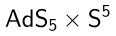 , but not in flat space-time)
the energy-momentum tensor and the
, but not in flat space-time)
the energy-momentum tensor and the  -ghost can also be interpreted as symmetric tensors
on the target space (see Mikhailov:2017mdo).
-ghost can also be interpreted as symmetric tensors
on the target space (see Mikhailov:2017mdo).
How to classify a generic odd nilpotent vector field ? A vector field can usually be “simplified” by
a clever choice of coordinates. This is called “normal form”.
If a vector field is non-vanishing,
one can choose coordinates so that the it is  where
where  is
one of fermionic coordinates. If vanishes at some point, then the normal form would be
(in the notations of Alexandrov:1995kv)
is
one of fermionic coordinates. If vanishes at some point, then the normal form would be
(in the notations of Alexandrov:1995kv)  .
But in out case, the target space is not a smooth supermanifold, because pure spinor ghosts live on a cone.
The vector vanishes precisely at the singular locus, and the problem of classification of normal forms is
a nontrivial cohomological computation. This is what we will do in this paper. We will find that
the space of equivalence classes of odd nilpotent vector fields in a vicinity of the singular locus
is equivalent to the space of the classical SUGRA solutions.
This is true modulo some “zero modes” —
.
But in out case, the target space is not a smooth supermanifold, because pure spinor ghosts live on a cone.
The vector vanishes precisely at the singular locus, and the problem of classification of normal forms is
a nontrivial cohomological computation. This is what we will do in this paper. We will find that
the space of equivalence classes of odd nilpotent vector fields in a vicinity of the singular locus
is equivalent to the space of the classical SUGRA solutions.
This is true modulo some “zero modes” —
Some details of our computations can be found in the HTML version of this paper.
Definition of
Our results
Relation to partial-structures
Divergence of a nilpotent vector field
Requiring
Vanishing of obstacles to nonlinear solution
Definition of 
with bosonic coordinates  (
( running from 1 to 10) and
 ,
,  (
( and
and  both running from 1 to 16),
and fermionic
both running from 1 to 16),
and fermionic  and
and  , with the constraint:

 are ten-dimensional gamma-matrices. These constraints are called “pure spinor constraints”.
We understand Eqs. (1) as specifying the singular
locus in , from the point of view of differential geometry. All we need from these
equations is to know how deviates from being smooth.
The singular locus is the tip of the cone (1):
are ten-dimensional gamma-matrices. These constraints are called “pure spinor constraints”.
We understand Eqs. (1) as specifying the singular
locus in , from the point of view of differential geometry. All we need from these
equations is to know how deviates from being smooth.
The singular locus is the tip of the cone (1):


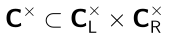
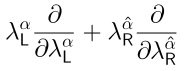 . satisfying the following properties:
- has ghost number 1, i.e.:

- is “smooth” in the sense that it can be
obtained as a restriction to the cone (1) of a smooth (but not nilpotent)
vector field
in the space parametrized by unconstrained

- is zero at
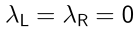
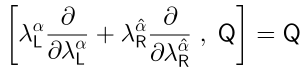
 such that
  satisfy the same constraints (1).
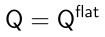 :
:



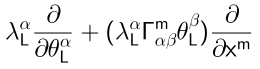

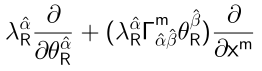 , some other structures which are less geometrically transparent
(various couplings in the string worldsheet sigma-model). All these structures should satisfy certain
consistency conditions.
, some other structures which are less geometrically transparent
(various couplings in the string worldsheet sigma-model). All these structures should satisfy certain
consistency conditions.
Question: is it true, that just a nilpotent vector field
already
includes, as various coefficients in its normal form, all the supergravity fields, and the supergravity
equations of motion are automatically satisfied (i.e. follow from )?
(i.e. they would only appear as some couplings in the sigma-model, but would not enter in ).
Second, it could be that just would not be enough to impose SUGRA equations
of motion (i.e. one would have to also require the -invariance of the
worldsheet sigma-model action).Our results
as a deformation of  :
:

 (i.e.
(i.e.  ).
It turns out that is parameterized by some tensor fields satisfying certain
hyperbolic partial differential equations. These fields are in one-to-one correspondence
with the fields of the Type II SUGRA, and our hyperbolic equations are the equations of motion
of the linearized Type II SUGRA.
).
It turns out that is parameterized by some tensor fields satisfying certain
hyperbolic partial differential equations. These fields are in one-to-one correspondence
with the fields of the Type II SUGRA, and our hyperbolic equations are the equations of motion
of the linearized Type II SUGRA.
 are generators of the gauge group, and
  is vector potential.
Zero solution corresponds to
is vector potential.
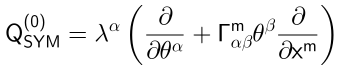
Zero solution corresponds to  . In this sense, the SYM solutions can be
considered as deformations of the differential operator:
. In this sense, the SYM solutions can be
considered as deformations of the differential operator:
|
Relation to partial -structures
 and
and  parametrize the normal direction to the
singularity locus
parametrize the normal direction to the
singularity locus  :
:
|
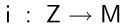
 with the fiber
  — with the fiber
  .
The vector field is power series in
.
The vector field is power series in  , with zero at the tip of .
The derivative of at the zero locus defines a linear map:
, with zero at the tip of .
The derivative of at the zero locus defines a linear map:
|

 only covers a
  -dimensional
subbundle of
-dimensional
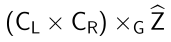
subbundle of  . We can interpret as
  where
where  is a partial frame bundle of and is given by Eq. (3).
It was shown in Mikhailov:2015sva that defines a connection in a partial
-structure on with some constraints on torsion, modulo some equivalence relation.
is a partial frame bundle of and is given by Eq. (3).
It was shown in Mikhailov:2015sva that defines a connection in a partial
-structure on with some constraints on torsion, modulo some equivalence relation.The relation to previous work on SUGRA constraints Nilsson:1981bn, Howe:1983sra, Witten:1985nt, Shapiro:1986xp, Chau:1988sm, Bergshoeff:1990mr, Bergshoeff:1991ei, Howe:1991bx, Howe:1991mf can be established along these lines.
Divergence of a nilpotent vector field
 , an integral form on .
Then we can consider, for any vector field
, an integral form on .
Then we can consider, for any vector field  , its divergence
  .
This is by definition the Lie derivative of along :
.
This is by definition the Lie derivative of along :
|
 , we can consider the cohomology class:
|
 .
.The cohomology class  plays two importan roles in our approach.
First, they allow to reduce the study of to the first infinitesimal neighborhood of the singularity
locus given by Eq. (2). Second, it allows to prove that there is no obstacle
to extending the linearized deformations (the term
plays two importan roles in our approach.
First, they allow to reduce the study of to the first infinitesimal neighborhood of the singularity
locus given by Eq. (2). Second, it allows to prove that there is no obstacle
to extending the linearized deformations (the term  in Eq. (7))
to higher orders in . We will now explain this.
in Eq. (7))
to higher orders in . We will now explain this.
Requiring 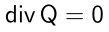
has ghost number one, see Eq. (5). But the “ghost number”
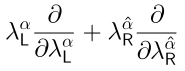 is coordinate-dependent. It is not invariant under a change of coordinates:
|


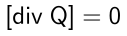 is a vector field of ghost number one plus
vector fields of ghost numbers two and higher.
Although we have not computed
is a vector field of ghost number one plus
vector fields of ghost numbers two and higher.
Although we have not computed 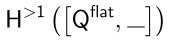 ,
the results of Mikhailov:2014qka suggest that
,
the results of Mikhailov:2014qka suggest that
|

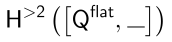 is zero modulo finite-dimensional spaces.
Then, Eq. (10) implies that the terms of the ghost number higher than one in can be removed
by the coordinate redefinition. In other words, the normal form of can be always choosen to be of the ghost nuber one.
It is enough to study the first infinitesimal neighborhood of the singularity locus.
is zero modulo finite-dimensional spaces.
Then, Eq. (10) implies that the terms of the ghost number higher than one in can be removed
by the coordinate redefinition. In other words, the normal form of can be always choosen to be of the ghost nuber one.
It is enough to study the first infinitesimal neighborhood of the singularity locus.Vanishing of obstacles to nonlinear solution
It is necessary to extend this analysis to full nonlinear SUGRA equations,
i.e. higher order terms in Eq. (7).
The potential obstacle to extending linearized solutions to the solution of the
nonlinear equation  lies in
 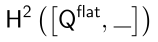 .
We will not compute in this paper,
but the results of Mikhailov:2014qka suggest that
is actually nonzero.
(We would expect it to be roughly isomorphic to
.
We will not compute in this paper,
but the results of Mikhailov:2014qka suggest that
is actually nonzero.
(We would expect it to be roughly isomorphic to 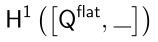 which we compute here.)
But we also know that the actual obstacle is zero, because of the consistency of the nonlinear supergravity
equations of Berkovits:2001ue. This means that
which we compute here.)
But we also know that the actual obstacle is zero, because of the consistency of the nonlinear supergravity
equations of Berkovits:2001ue. This means that 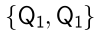 must be a coboundary.
In our language, this can be proven in the following way.
Let us choose so that the divergence of is zero.
The divergence of , and therefore of ,
is
must be a coboundary.
In our language, this can be proven in the following way.
Let us choose so that the divergence of is zero.
The divergence of , and therefore of ,
is  -exact (this statement does not depend on the choice of ). This is because
  has
ghost number 1. The cohomology at ghost number 1 is finite-dimensional, and in fact those with nonzero
has
ghost number 1. The cohomology at ghost number 1 is finite-dimensional, and in fact those with nonzero
 are non-physical
(see Mikhailov:2014qka and references there).
At the same time, the divergence of the elements of
is nonzero. Therefore the obstacle actually vanishes.
are non-physical
(see Mikhailov:2014qka and references there).
At the same time, the divergence of the elements of
is nonzero. Therefore the obstacle actually vanishes.