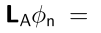
AdS notations
Embedding formalism
We here consider massless Laplace equation in

.
We realize
as a hyperboloid in

parametrized by coordinates

.
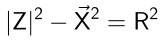
The equation of the hyperboloid is:
where
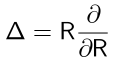
and

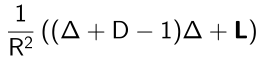
is the Laplace operator on
.
Therefore, on harmonic functions:
Our space-time is not just
, but
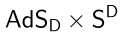
. The formulas for Laplace operator on the sphere
are completely analogous. To distinguish between AdS and sphere, we use indices

and

:

,

,

,

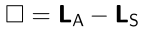
. The total Laplace operator
on
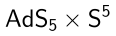
is:
Therefore, for the scalar function to be harmonic in
:
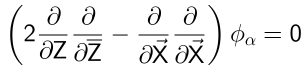
This means:
Solutions of wave equations
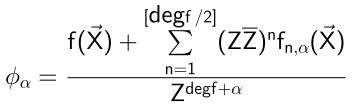
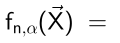
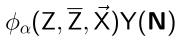
Consider the following family of scalar field profiles, parameterized by a real parameter  :
:
where

can be determined recursively from:
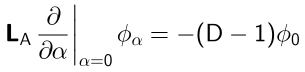
This solves the wave equation in
Therefore:
Massless scalar in
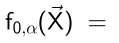
To solve the wave equation on
, we take

:
Massless scalar in
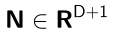
Let us parametrize

by a unit vector
.
Suppose that the
dependence is a harmonic polynomial

of order
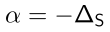
. We must either take
or

. The solution is:
Inhomogeneous equations, appearence of log terms
Consider the equation with nonzero right hand side:

. When

is proportional to

, the logarithmic terms appear. Indeed:
and therefore:
This expression contains

.
A somewhat special case is the equation:
The solution is:
One can think of

as a family, parametrized by
, of field profiles,
taking values in a different representation for each
. (All these representations
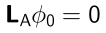
are subspaces of one large space.) The value of the Casimir operator
is given
by Eq. (
77). When

it is zero.
From this point of view, Eq. (
78) is a particular case of the following
general construction. Suppose that we have an operator

acting on a representation space

of

,
commuting with
,
and
is a continuous direct sum of subrepresentations

parametrized by a parameter
,
such that the restriction of
on each
is the multiplication by
.
For

, we want to find

such that

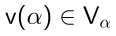
. Consider a 1-parameter family
of vectors
such that
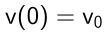
. Then
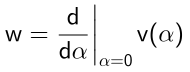
. We only need a 1-jet of
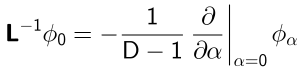
the family. If it is possible to find a map:
commuting with
with the symmetry, then the equation
can be solved in a covariant way:
For example, if
were equipped with a metric, we could pick for each

the path
going through
with the velocity perpendicular to

. But in our context,
there is no invariant metric, and there is no

-covariant invertion of
.
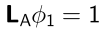
We can construct a sequence of

-independent functions:
They all depend only on

and grow near the boundary of AdS
as powers of

.
Functions participating in the perturbative expansion of nonlinear beta-deformation
We expect that nonlinear beta-deformation (and other finite-dimensional deformations)
is expressed in terms of
functions  of Eq. (80) and their derivatives w.r.to
  and
and  ,
multiplied by polynomials of
,
multiplied by polynomials of  and rational functions of
  .
.