Discussion and open questions
A general theme of AdS/CFT is comparison of field theory computations with supergravity
computations. The analysis of the present paper is incomplete, and potentially leaves
a mismatch between field theory and supergravity.
Indeed, on the field theory side we use the formalism
of Section Renormalization of the deformations of the action, Symmetries of undeformed theory act on deformations, Geometrical abstraction.
While on the supergravity side, we use the formalism of Sections Geometrical abstraction,
Normal form of the action of  , which is similar but different.
Is it true that symmetries of QFT naturally act on the space of its deformations?
It is essential for our reasoning, that there is a natural action of the symmetries of QFT on the space of its deformations, Section Symmetries of undeformed theory act on deformations. This action should be natural, i.e. should not depend on how we describe deformations. Strictly speaking, our reasoning in Section Symmetries of undeformed theory act on deformations used a particular way of thinking about the deformations. Therefore, we are in danger of using an unnatural definition.
Gauge group is not an invariant
.
But gauge group is not actually an invariant of the theory
Gauge transformations characterize the redundancy of the given Lagrangian desciption of the theory. A different Lagrangian descriptions of the same theory can have slightly different gauge symmetries.
actually depend, in some sense, on the cohomology of the gauge transformations.
Our construction uses certain “flabbyness” of the algebra of gauge transformations,
essentially allowing to reduce the cohomologies to those of  (using the Shapiro’s lemma).
We hope that the cohomologies are invariant.
(using the Shapiro’s lemma).
We hope that the cohomologies are invariant.Maybe there is no mismatch
hold, namely:
Exists
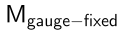 and
andSolution of MC Equation does not depend on the choice of
just match the invariants on the QFT side,
so there is no discrepancy.
We think that this is, most likely, what actually happens.Computation of the MC invariants
As we already mentioned in Section Outline of computation, an important open question is to develop the homological perturbation theory of [Bedoya:2010qz,Benitez:2018xnh] and to actually compute the Maurer-Cartan invariants which we defined.