Supergravity in AdS space
Holographic renormgroup
Consider Type IIB SUGRA in 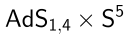 and
and  supersymmetric Yang-Mills on the boundary.
We can proceed in two ways, which are equivalent because of the AdS/CFT duality:
supersymmetric Yang-Mills on the boundary.
We can proceed in two ways, which are equivalent because of the AdS/CFT duality:
- Renormgroup flow on the boundary
We choose some map from the space
of linearized deformations of the SYM theory to the space of finite deformations.
There is no way to fix such a map preserving  ,
so we want to study the deviation from -invariance, in the context
of Section Obstacles to linearization of symmetry.
,
so we want to study the deviation from -invariance, in the context
of Section Obstacles to linearization of symmetry.
- Classical solutions of SUGRA in the bulk
We fix some map
from the space of solutions of the linearized SUGRA equations to the space of
nonlinear solutions. Then we study the deviation of this map from being
-invariant as in Section Obstacles to linearization of symmetry.
Here we will discuss this second approach. In fact, is a subalgebra of a larger superalgebra,
the superalgebra of gauge transformations of supergravity.
This requires a generalization of the formalism of Section Obstacles to linearization of symmetry
which we will describe in Section Geometrical abstraction.
Gauge transformations of supergravity
The precise description of the gauge transformations of supergravity depends, generally
speaking, on the formalism.
Any theory of supergravity necessarily includes the group of space-time super-diffeomorphisms
(= coordinate transformations), as gauge transformations.
Those theories which have B-field should also include gauge transformation of the B-field.
In the case of bosonic string they have been recently discussed in Schulgin:2014gra.
In bosonic string, gauge transformations correspond to BRST exact vertices Schulgin:2014gra.
In the pure spinor formalism, we are not aware of any reference discussing specifically
gauge transformations. Apriori the coordinate transformations should also include
transformations of pure spinor ghosts; they are in fact gauge-fixed Berkovits:2001ue.
Our approach to holographic renormgroup is based on the study of the normal form of the action of the
group of SUGRA gauge transformations in the vicinity of the AdS solution.
We will now develop a geometrical abstraction for that.
The construction parallels Section Geometrical abstraction, the main difference being
that instead of a point  we have to consider a degenerate orbit
  .
We will now explain the details.
.
We will now explain the details.
Geometrical abstraction
Consider a Lie supergroup

acting on a supermanifold

with a subgroup

preserving a point
.
Moreover, we will assume that:
Let

denote the orbit of

:
In the context of holographic renormgroup:
Introduce the coordinates

on
, and coordinates

in the transverse direction
to
.
Consider the normal bundle

of
:
The action of
on
induces the action of
on
. Let

denotes the formal neighborhood of
in
. It also comes with an action of
.
Consider the following question: can we find a family of maps, parameterized by

:
(46)
satisfying (
cp Eqs. (
6), (
7), (
8)):
commuting with the action of
?
It turns out that the obstacle exists already at the linearized level.
Normal bundle is not the same as the first infinitesimal neighborhood.
The space of functions on  is not the same, as a representation of
  , as the
space of functions on constant-linear on fibers — see Eq. (53) below.
, as the
space of functions on constant-linear on fibers — see Eq. (53) below.
We will now proceed to the study of the obstacles to the existence of  .
.
Normal form of the action of
Locally near the point
, the normal bundle to
can be trivialized. Let
denote
the coordinates on
, and
coordinates in the fiber. Then, the equation of
is:
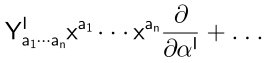
General vector field tangent to
Let us fix some satisfying Eqs. (47), (48),
(49).
Since acts on , every element of the Lie algebra  defines a vector field
  on .
on .
Then,

is a vector field on
:
It should satisfy:
The power of

correlates with the degree in

-expansion. As an abbreviation, we will omit
in the following formulas.
Big Maurer-Cartan equation
Let us introduce the Faddeev-Popov ghosts

for
.
Let us denote:
Reduction to 
We want to reduce from to , for the following reasons:
Therefore, we will now investigate the reduction to
. We will start by concentrating
on the vicinity of the point

.
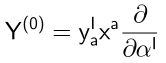
Let us concentrate on the vicinity of the point  . Suppose that at the point :
  .
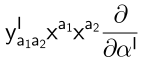
Again, we will separate into linear and non-linear part.
For
.
Again, we will separate into linear and non-linear part.
For  (i.e. the stabilizer of ),
 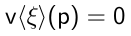 , therefore:
Schematically:
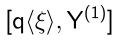
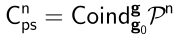
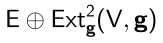
This defines the extension of the physical states with gauge transformations:
The tensor

defines a cocycle —
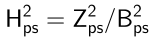
an element of

. Its class in
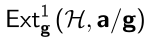
is the obstacle to finding a
-invariant map
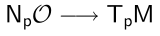
.
If this obstacle is zero, then by a linear coordinate redefinition we can put

,
i.e.

.
In fact, we want to remove all

, not only

.
The first non-vanishing coefficient
defines a class in:
If nonzero, this is a cohomological invariant.
It is not clear to us how to interpret such
invariants on the field theory side.
It was proven in
Mikhailov:2011si that the sequence (
53) splits for

of large
enough spin. In Section
Description of beta-deformation in pure spinor formalism we will prove that it splits for beta-deformation, which is
the representation of the smallest nonzero spin.
Motivated by these observations, we will assume in the following discussion that (
53) always splits.
Moreover, we assume that all the obstacles in (
54) vanish.
(Not that the whole cohomology group
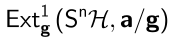
vanishes, but the actual invariant is zero.) If true, this is a nonlinear analogue of the covariance property of the vertex
discussed in
Mikhailov:2011si.
Assuming that there are no obstacles of the type Eq. (54)
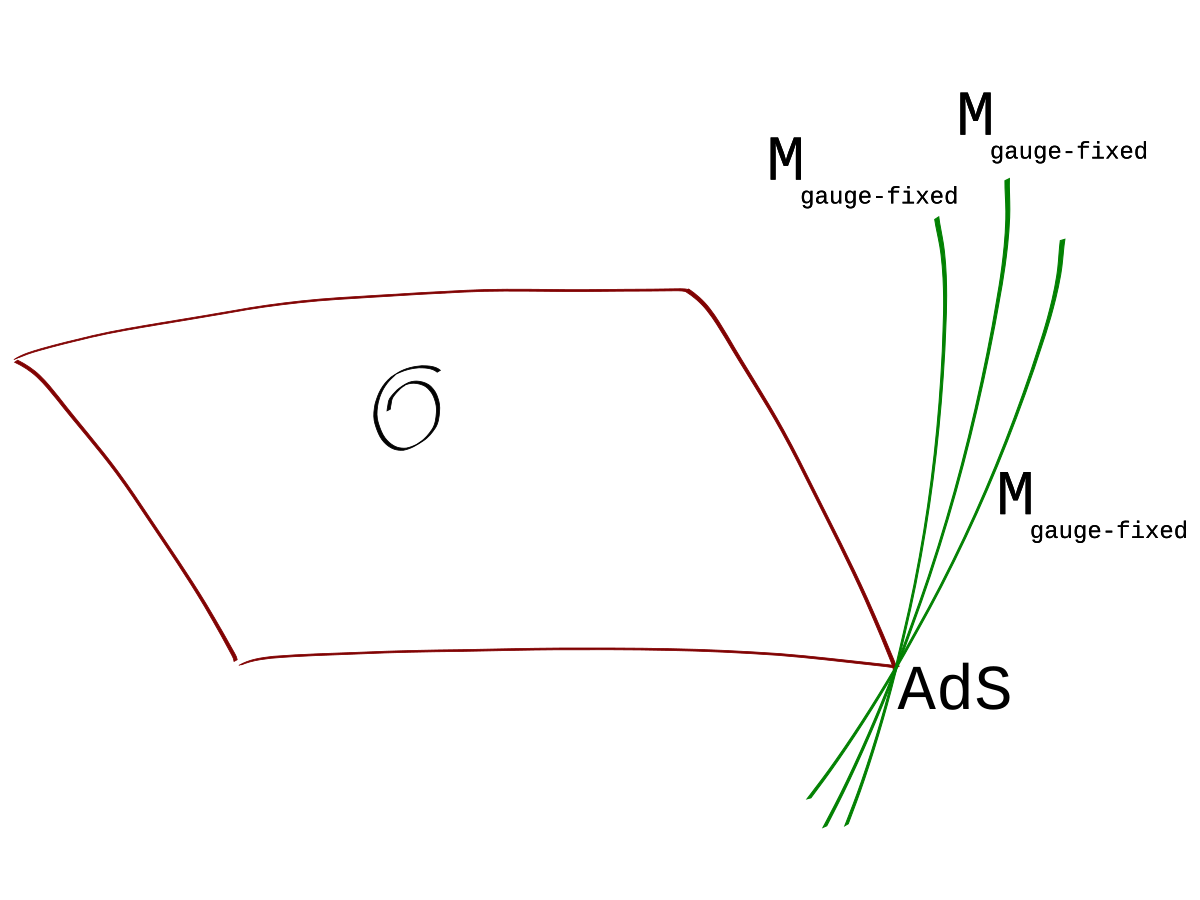
and 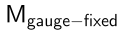
If the obstacles of the type Eq. (54) are all zero up to some value of  ,
then we can remove all
,
then we can remove all 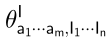 with
with  , so we are left with:
Geometrically this means that we can find a
-invariant submanifold
which
intersects
transversally at the point
. It is given by the equation

.
In this case,
for

defines a vector field on
,
and a solution of the Maurer-Cartan equation.
Let

be the Faddeev-Popov ghost for

. Restriction of

to
is:
Let us denote:
We then observe that

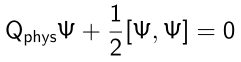
satisfies the Maurer-Cartan equation:
Is an invariant? Deformations of .
Therefore, an action of on the vicinity of defines some solution
of the Maurer-Cartan Eq. (55). A gauge transformation  corresponds a change of coordinates on .
But is it true that modulo such gauge transformations is an invariant?
Generally speaking the answer is negative, for the following reason:
may be deformable, different choices of leading to different ,
apriori not related by a gauge transformations of the form .
Therefore, we have to study the deformations of .
Geometrical picture
Deformations of a
-invariant submanifold
are given by
-invariant sections of its normal bundle
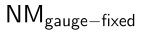
.
An exact sequence
implies the existence of a canonical map
:
The space

can be naturally identified with the
tangent space to the space of solutions of the Maurer-Cartan Eq. (
55) modulo gauge transformations:
Therefore, when

, solution of MC equation depends on the choice of
.
This means that we have, generally speaking, a
family of invariants.
In coordinates
Remember that
is given by the equations:
Infinitesimal deformations of
can be obtained as fluxes by vector fields of the form
(57)
where
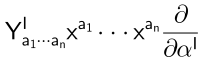
commute with

.
In other words, the tensor field

defines an element of
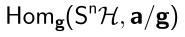
.
The flux of such vector fields preserves the condition that
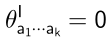
for

.
To keep
for

, we need to add to ((
57))
some terms of higher order in
(the

in Eq. ((
57)));
the existence of such terms depends on the vanishing of
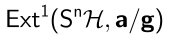
.
For example, consider a vector field

:
where

is a
-invariant tensor in
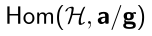
.
The commutator
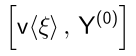
contains terms:
They automatically satisfy:
and under the assumption of vanishing
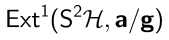
exists

:
Therefore we can construct, order by order in
-expansion, a vector field:
defining a
-invariant section of the normal bundle of
, and
therefore a deformation of
as a
-invariant submanifold.
The corresponding deformation of
is:
We do not see any apriori reason why this

could be absorbed by a gauge
transformation,
i.e. why would exist

such that
.
Conclusion
We have studied the problem of classifying the normal forms of the action of a Lie supergroup
in the vicinity of an orbit with nontrivial stabilizer.
As invariants of the action, we found families of equivalence classes
of solutions of MC equations modulo gauge transformations.
These families are parameterized by -invariant submanifolds .
Remember that is a finite-dimensional
Lie superalgebra, while is infinite-dimensional, and therefore is infinite-dimensional.
One would think that
the deformations of “along ” will be “as complicated as ”.
That would be ugly. But in fact, the space of deformations
of is “no more complicated than ”. For examle, when is
finite-dimensional, the space of deformations is also finite-dimensional at each order in .
Roughly speaking, at the order , it is .
Even though
may be non-zero, it is certainly nicer than  .
.
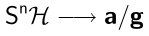
In other words, the deformations of do not involve the dependence on all ,
but only on finite-dimensional subspaces, the images of intertwining operators
 .
.
Pure spinor formalism
Here we will briefly outline the pure spinor implementation of supergravity in the vicinity
of AdS.
We use the notations of
Mikhailov:2011si.
Let

be the subalgebra preserving a point in
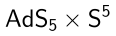
.
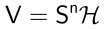
In the pure spinor formalism, the space of vertex operators (cochains) of ghost number
transforms
in an induced representation of
:
where

is the space of homogeneous polynomials of the order
on the pure spinor variable.
The space of linearized SUGRA solutions corresponds to the cohomology at ghost number

:
This defines an extension of
with

:
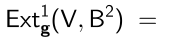
The structure of extension is described by a cocycle
The extension is nontrivial iff

defines a nontrivial class in
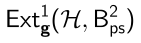
.
This class is an obstacle to the existence of a covariant vertex.
We have seen (Section Reduction to ) that, more generally, 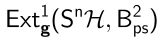 are obstacles to finding a -invariant gauge for nonlinear solutions.
We will now show that , although nonzero, is in some sense small.
are obstacles to finding a -invariant gauge for nonlinear solutions.
We will now show that , although nonzero, is in some sense small.
Let us denote:
Notice that

fits in a short exact sequence or representations,
with the corresponding long exact sequence of cohomologies:
Shapiro’s lemma implies that

.
For example, for
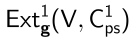
we have:
because

is semisimple as a representation of

, and
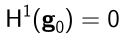
.
Therefore:
Notice that

is in the following exact sequences
(the pure spinor cohomology at ghost number one,

, corresponds to the global symmetries
.):
BRST exact vertices of ghost number one,
i.e. 
, fit in the following exact sequences:
These observations together imply that
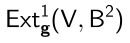
fits into a short exact sequence of linear
spaces:
This means that
is a direct sum:
Notice that

is a factorspace of a subspace of
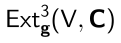
.
In this sense,
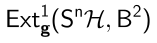
is “lesser than”:
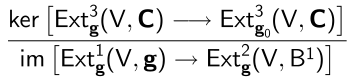
This is the “upper limit” on the cohomology group containing the obstacle to
the existence of
at the order
in
-expansion.
When  In particular corresponds to the obstacle to the existence of a covariant vertex,
i.e. to the splitting of the short exact sequence of Eq. (58).
In Section Description of beta-deformation in pure spinor formalism we will show that the actual obstacle is zero in the case of
linearized beta-deformation (which is the representation with smallest spin).
At the same time, results of Mikhailov:2011si imply that the obstacle is zero for
linearized solutions with large enough spin. The conjectured existence of covariant vertices
is the interpolation between these two cases.
In particular corresponds to the obstacle to the existence of a covariant vertex,
i.e. to the splitting of the short exact sequence of Eq. (58).
In Section Description of beta-deformation in pure spinor formalism we will show that the actual obstacle is zero in the case of
linearized beta-deformation (which is the representation with smallest spin).
At the same time, results of Mikhailov:2011si imply that the obstacle is zero for
linearized solutions with large enough spin. The conjectured existence of covariant vertices
is the interpolation between these two cases.
If does not exist
We do not have a proof that the obstacle in
defined in Section Reduction to is actually zero.
If it is not zero, then we cannot restrict to (because does not exist).
Then we must study the full expansion of  of Eq. (52), in powers of both
and .
of Eq. (52), in powers of both
and .
However, we do not need to take into account all . We only need those which
represent the obstacle in . Therefore,
the complication is not actually as bad as it could have been. The main point is that,
even though seems an ugly infinite-dimensional space, its cohomologies
are reduced to expressions like (59)
by the “magic” of the Shapiro’s lemma.
In the rest of this Section we will accept as a working hypothesis that exists.
Also, we will leave open the question of non-uniqueness of .
Normalizable SUGRA solutions
“Normalizable” means decreasing sufficiently rapidly near the boundary.
All linearized normalizable SUGRA solutions are periodic in the global time  .
They approximate some complete (nonlinear) solutions. The nonlinear solutions are not periodic.
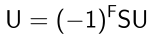
But, since linearized solutions are periodic, we can define the monodromy transformation
.
They approximate some complete (nonlinear) solutions. The nonlinear solutions are not periodic.
But, since linearized solutions are periodic, we can define the monodromy transformation
 as in Section Monodromy transformation.
The space of normalizable (
i.e. rapidly decreasing at the boundary) solutions
has a symplectic form. This is true at the linearized level as well as for the
non-linear solutions. Then we can choose a map
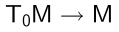
so that it preserves
the symplectic structure
.
Therefore, we can now identify
with the corresponding Hamiltonian, which we denote

,
or just

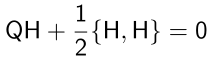
. The MC equation (
13) becomes:
Remember that
is of cubic and higher order in the coordinates on

.
Given the monodromy matrix of Eq. (
17) we can (in perturbation theory)
define a vector field

such whose flux generates it:
It has some Hamiltonian

which is of cubic and higher order
in the coordinates on
. In some sense, the quantization of
should give the
spectrum of anomalous dimensions. This program is complicated, though, by a non-straigthforward action
of the symmetry, see Section
Symmetries.
Non-normalizable SUGRA solutions
The non-normalizable SUGRA solutions correspond to the deformations of the boundary theory.
Consider the following element of
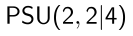
—
the symmetry group of
:
Suppose that our deformation is invariant under

:
Then, the corresponding linearized solution is periodic in the global time of AdS.
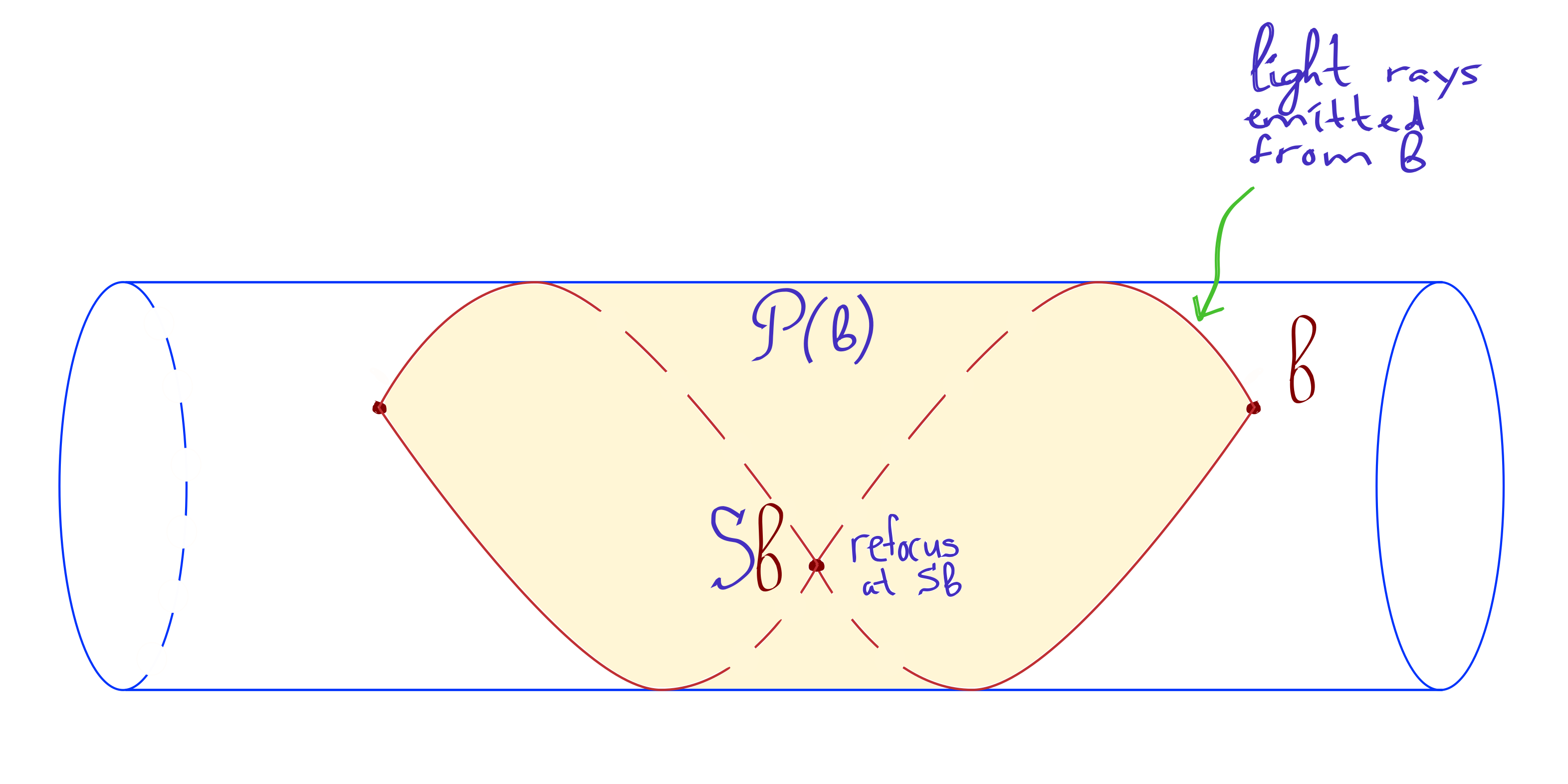 Transformation
  , as it acts on the boundary of AdS
Indeed, let us consider the retarded wave generated by an insertion of some operator
at the point

on the boudary. It is the same as retarded boundary-to-bulk propagator.
It is a generalized function with support on the future light cone of
.
Let

be a light-like vector encoding the point
on the boundary.
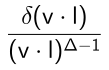
Then the boundary-to-bulk propagator, in sufficiently small neighborhood of
is, schematically:
where
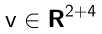
with
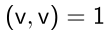
corresponds to a point inside AdS;

is the conformal dimension of
. The future light cone gets re-focused
at

. The free solution (
61) gets then reflected from
the boundary at the point
, and when reflected changes sign. Therefore, in order to
cancel the reflection, we have to put the same operator at the point

.
However, the corresponding nonlinear solution may or may not be periodic.
If it is not periodic, then the deviation from
periodicity is characterized by the monodromy of Eq. (17).
In any case, the solution of the Maurer-Cartan equation is more fundamental
than the monodromy transformation.
Simplest non-periodic linearized solution
(This subsection is a side remark.)
As we mentioned in Section Normalizable SUGRA solutions, all normalizable linearized
solutions are periodic in global time .
But of course, this is not true for non-normalizable solutions. (Indeed, nothing prevents
us from considering non-periodic boundry conditions at the boundary of AdS. There exist
corresponding solutions, which are not periodic.) As a simplest example, consider the dilaton
linearly dependent on
:
This is a solution of SUGRA only at the linearized level. Indeed, the energy

is
nonzero, and it will deform the metric. It would be interesting to see if it approximates
some solution of nonlinear equations with the following property: the action of

on it
is the shift of dilaton.
If we act on  of Eq. (62) by generators of ,
we get an infinite-dimensional representation.
This infinite-dimensional representation contains a 1-dimensional invariant subspace, because
the action of gives constant.
(But the action of
of Eq. (62) by generators of ,
we get an infinite-dimensional representation.
This infinite-dimensional representation contains a 1-dimensional invariant subspace, because
the action of gives constant.
(But the action of  and
and  of Eqs. (33), (34) results
in expressions like
of Eqs. (33), (34) results
in expressions like  , etc, an infinite-dimensional space.)

 -field
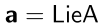 is
its Lie superalgebra
is
its Lie superalgebra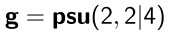 its Lie superalgebra






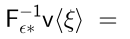








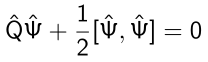
 of Eq. (51) is too complicated. Instead of acting
on functions of
of Eq. (51) is too complicated. Instead of acting
on functions of 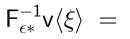











is the kernel of the natural map