Obstacles to linearization of symmetry
Action of a symmetry in local coordinates
Suppose that a Lie algebra  acts on a manifold
  and leaves invariant
a point
and leaves invariant
a point  . Then naturally acts in the tangent space
  .
Consider maps
.
Consider maps 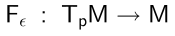 parameterized by a small parameter
  ,
satisfying:
,
satisfying:
acts on a manifold and leaves invariant
a point . Then naturally acts in the tangent space .
Consider maps parameterized by a small parameter ,
satisfying:

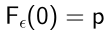

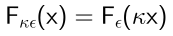
As we discussed in Section Geometrical abstraction, there are many such maps.
Let us ask the following question: is it possible to construct such a map  which would also commute with the action of ?
(We are interested in a formal map, i.e. a map specified as an
infinite series in ; we will not discuss convergence.)
which would also commute with the action of ?
(We are interested in a formal map, i.e. a map specified as an
infinite series in ; we will not discuss convergence.)
which would also commute with the action of ?
(We are interested in a formal map, i.e. a map specified as an
infinite series in ; we will not discuss convergence.)Let us start by picking some map 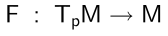 (not necessarily
  -invariant)
satisfying Eqs. (6), (7) and (8).
For each element
-invariant)
satisfying Eqs. (6), (7) and (8).
For each element  there is a corresponding vector field
  on . Let us
consider
on . Let us
consider  . It is a vector field on :
(not necessarily -invariant)
satisfying Eqs. (6), (7) and (8).
For each element there is a corresponding vector field on . Let us
consider . It is a vector field on :

where  is of the form
 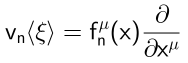 with
with  a polynomial of the degree
  in
in  .
.
is of the form with a polynomial of the degree in .Notice that the power of in Eq. (9) correlates with the degree in of
. Therefore we will just skip from our formulas; we will think of “ being of the
order ”.
The vector field  has a very straightforward meaning. Our map
  turns a sufficiently small
open neighborhood of
turns a sufficiently small
open neighborhood of 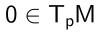 into a chart of . In this context, is just the
“coordinate representation” of the vector field in that chart. Therefore, our question
becomes:
into a chart of . In this context, is just the
“coordinate representation” of the vector field in that chart. Therefore, our question
becomes:
has a very straightforward meaning. Our map turns a sufficiently small
open neighborhood of into a chart of . In this context, is just the
“coordinate representation” of the vector field in that chart. Therefore, our question
becomes:
Can we choose a chart so that
 ?
?
We will see that obstacles are certain cohomology classes.
Maurer-Cartan equation
For two elements  and
and  of , we have:
and of , we have:
|

This means that, for  :
:
:

where  ,
,  denote the coordinates on
  . Besides that:
, denote the coordinates on . Besides that:
|

Define the “BRST operator”:
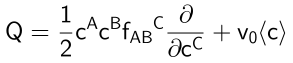
where 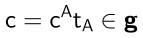 . We have
  . This defines the differential in the Lia algebra
cohomology complex Knapp of with values in the space of vector fields on having zero
of at least second order at the point
. This defines the differential in the Lia algebra
cohomology complex Knapp of with values in the space of vector fields on having zero
of at least second order at the point  . (The action of the second term,
  ,
is by the commutator of vector fields.)
,
is by the commutator of vector fields.)
. We have . This defines the differential in the Lia algebra
cohomology complex Knapp of with values in the space of vector fields on having zero
of at least second order at the point . (The action of the second term, ,
is by the commutator of vector fields.)
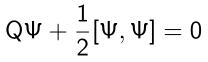
Eq. (10) implies that  satisfies the MC equation:
satisfies the MC equation:
Gauge transformations
Suppose that we replace 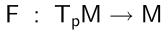 with another function
 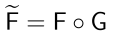 , where
 is any (nonlinear) function
 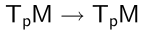 such that
 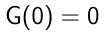 and
and 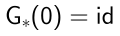 . Then gets replaced with
 where:
with another function , where
is any (nonlinear) function such that and . Then gets replaced with
where:

This is the gauge transformation. An infinitesimal gauge transformation is:

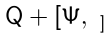
Tangent space to the moduli space of solutions of MC equation
|

The Lie algebra of nonlinear
i.e. quadratic and higher orders in coordinates
vector fields
has a filtration by the scaling degree. Therefore the cohomology of 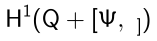 can be computed by a spectral sequence.
The first page of this spectral sequence is:
can be computed by a spectral sequence.
The first page of this spectral sequence is:
can be computed by a spectral sequence.
The first page of this spectral sequence is:

where 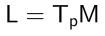 .
.
.Monodromy transformation
Additional assumption
We now have two actions of on : the linearized one, which is given by  of
Eq. (9), and the nonlinear action given by
of
Eq. (9), and the nonlinear action given by  .
Suppose that the linearized one integrates to some action
.
Suppose that the linearized one integrates to some action  of a group :
on : the linearized one, which is given by of
Eq. (9), and the nonlinear action given by .
Suppose that the linearized one integrates to some action of a group :
|
| ||||||||
|
|

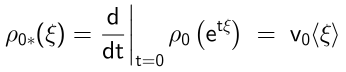
Suppose that this group has a non-contractible one-dimensional cycle.
has a non-contractible one-dimensional cycle.Consider the path ordered exponential over this non-contractible cycle. Without loss of generality,
we can start and end the loop at the unit. We define:




where  is the action of on
  . This is the monodromy transformation:
is the action of on . This is the monodromy transformation:
|

Notice that the derivative of  at the point is zero. Therefore we can define
its second derivative:
at the point is zero. Therefore we can define
its second derivative:
at the point is zero. Therefore we can define
its second derivative:
|

Eq. (17) implies:
|
| ||||||||
|
|

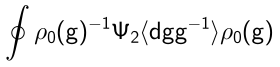

Usually the cycle is such that  is constant. Then the meaning of
the integration in Eq. (18), is that that we pick the resonant terms
in the quadratic vector field
is constant. Then the meaning of
the integration in Eq. (18), is that that we pick the resonant terms
in the quadratic vector field  .
.
is constant. Then the meaning of
the integration in Eq. (18), is that that we pick the resonant terms
in the quadratic vector field .Symmetries
The monodromy transformation commutes with the action of , but we have to remember that the action of
is given by nonlinear vector fields — of Eq. (9), life would be easier. But this is, generally speaking, not the case. Notice that
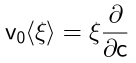 . Instead of
 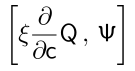 being zero, we have:
commutes with the action of , but we have to remember that the action of
is given by nonlinear vector fields — of Eq. (9), life would be easier. But this is, generally speaking, not the case. Notice that
. Instead of being zero, we have:

But  of Eq. (18) does commute with the undeformed action of on
( i.e. with ). This is because
of Eq. (18) does commute with the undeformed action of on
( i.e. with ). This is because  are of quadratic and higher order, and the first
derivative of vanishes.
are of quadratic and higher order, and the first
derivative of vanishes.
of Eq. (18) does commute with the undeformed action of on
( i.e. with ). This is because are of quadratic and higher order, and the first
derivative of vanishes.Sometimes is zero on some subspace 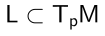 . Then, on this subspace, we can define the
third derivative
. Then, on this subspace, we can define the
third derivative  . Suppose that, in addition, the restriction of on
  is parallel to , i.e.:
is zero on some subspace . Then, on this subspace, we can define the
third derivative . Suppose that, in addition, the restriction of on is parallel to , i.e.:
|
| ||||||||
|
|

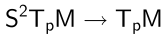

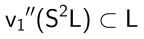
Then commutes with the undeformed action of on .
commutes with the undeformed action of on .Closed subsectors
Suppose that , as a representation of , has an invariant subspace:
, as a representation of , has an invariant subspace:
|
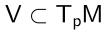
It may happen that the restriction of to  is tangent to . This, essentially,
means that
is tangent to . This, essentially,
means that  is closed under the action of the symmetry. In particular, the monodromy
transformation of Section Monodromy transformation acts within .
The sufficient condition for this is:
is closed under the action of the symmetry. In particular, the monodromy
transformation of Section Monodromy transformation acts within .
The sufficient condition for this is:
to is tangent to . This, essentially,
means that is closed under the action of the symmetry. In particular, the monodromy
transformation of Section Monodromy transformation acts within .
The sufficient condition for this is:
|
