Introduction
Renormalization of the deformations of the action
 invariant under some Lie algebra of symmetries
  .
Let us study its infinitesimal deformations of the theory, corresponding to the deformations of the action:
.
Let us study its infinitesimal deformations of the theory, corresponding to the deformations of the action:
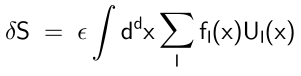
 is an infinitesimal parameter,
  are some space-time-dependent coupling constants
and
are some space-time-dependent coupling constants
and  is some set of local operators,
closed under in the sense that the expressions on the RHS of Eq. (1)
form a linear representations of . We call
is some set of local operators,
closed under in the sense that the expressions on the RHS of Eq. (1)
form a linear representations of . We call  the linear space of this representation
|
 the set of all local operators of the theory.
But there could be smaller -invariant subspaces.-matrix,
of the deformation of the form (1), to the linear order in .
We can also study the effects
of the deformation (1) beyond linear order in ,
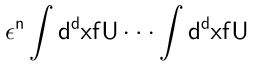
but this requires taking care of the definitions. To define (1), we expand in powers of ,
bringing down from the exponential expressions like:
the set of all local operators of the theory.
But there could be smaller -invariant subspaces.-matrix,
of the deformation of the form (1), to the linear order in .
We can also study the effects
of the deformation (1) beyond linear order in ,
but this requires taking care of the definitions. To define (1), we expand in powers of ,
bringing down from the exponential expressions like:
 .
Suppose that the set is big enough in the sense that all the required
counterterms are linear combinations of . The counterterms are not unique,
because we can always add a finite expression. Suppose that we have choosen some rule to fix this ambiguity.
Then, we have a map, parameterized by a small parameter :
.
Suppose that the set is big enough in the sense that all the required
counterterms are linear combinations of . The counterterms are not unique,
because we can always add a finite expression. Suppose that we have choosen some rule to fix this ambiguity.
Then, we have a map, parameterized by a small parameter :

Symmetries of undeformed theory act on deformations
The space of finite deformations is not, in any useful sense, a linear space.
It is a “nonlinear infinite-dimensional manifold”.
But it naturally comes with an action of .
Indeed, the regularized expression
(2) is, in particular, a (non-local) operator in the original theory.
As the symmetry group of the undeformed theory acts on operators, it therefore
acts on deformations, bringing one deformation to another.
Because we had some freedom in the choice of regularization, the map  does
not necessarily commute with the action of .
Can we choose regularization
with some care, so the resulting does commute with ?
Of course, we can not, there are obstacles.
does
not necessarily commute with the action of .
Can we choose regularization
with some care, so the resulting does commute with ?
Of course, we can not, there are obstacles.
In this paper we will introduce a geometrical framework for describing these obstacles and to what they correspond in the strong coupling limit via AdS/CFT duality.
Holographic renormalization
AdS/CFT correspondence relates the deformations of CFT to the classical solutions of SUGRA deforming AdS.
As main example,
consider Type IIB SUGRA in 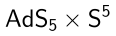 and
and  SYM on the boundary
 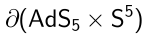 .
Deformations of the SYM action of the form (1) are mapped by AdS/CFT to the
classical SUGRA solutions, deformations of . Linearized SUGRA solutions correspond to
linearized deformations.
.
Deformations of the SYM action of the form (1) are mapped by AdS/CFT to the
classical SUGRA solutions, deformations of . Linearized SUGRA solutions correspond to
linearized deformations.
Renormalization of the deformations of QFT (Section Renormalization of the deformations of the action) should correspond to something on the AdS side. Most of the work on holographic renormalization was done along the lines of [Bianchi:2001kw,Skenderis:2002wp], and was based on the study of the bulk supergravity action.
On the other hand, the computation of the renormgroup flow of the beta-deformation done in Aharony:2002hx seems to use a different method. In particular, the authors of Aharony:2002hx did not need to know the action of the bulk theory. This, in particular, may allow to apply their method to the cases where the action is not known and maybe even does not exists, such as higher spin theories [Vasiliev:2004qz,Sharapov:2017yde].
acts on a manifold  , preserving a point
  .
Then it acts in the tangent space to at . The question is, can we find a formal map:
.
Then it acts in the tangent space to at . The question is, can we find a formal map:
 (“formal” means power series in ) from the tangent space to
  to , commuting with
the action of ? There are, generally speaking, obstructions to the existence of such a map
— in the vicinity of the fixed point.
to , commuting with
the action of ? There are, generally speaking, obstructions to the existence of such a map
— in the vicinity of the fixed point.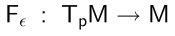 participate in the “usual” definition of the tangent space
( e.g. Arnold).
The tangent space
participate in the “usual” definition of the tangent space
( e.g. Arnold).
The tangent space  is defined as the space of equivalence classes of paths (maps from
  to )
to )  such
that
such
that 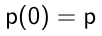 . The equivalence relation is that two paths
  and
and  are equivalent when
 in a coordinate patch. Giving a function as in
Eq. (4) is same as giving a prescription of how to pick, for each tangent vector
in a coordinate patch. Giving a function as in
Eq. (4) is same as giving a prescription of how to pick, for each tangent vector  ,
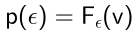
one path from the corresponding equivalence class. That path is:
,
one path from the corresponding equivalence class. That path is:
|
 ?
? such that can be denoted
  —-based loops in , but we only need a formal power series
in at
—-based loops in , but we only need a formal power series
in at  , not the whole loop. To summarize, we investigate the existence of a map:
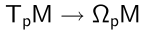 .
We find that there are obstacles to the existence of such a map, and classify them. These obstacles
are, roughly speaking, some cohomology groups. More precisely, they are solutions of a Maurer-Cartan
equation, modulo gauge transformations (a nonlinear analogue of cohomology groups) —
.
We find that there are obstacles to the existence of such a map, and classify them. These obstacles
are, roughly speaking, some cohomology groups. More precisely, they are solutions of a Maurer-Cartan
equation, modulo gauge transformations (a nonlinear analogue of cohomology groups) —The role of supergeometry and infinite-dimensional geometry
In our main application (AdS/CFT): 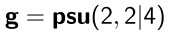 —
—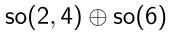 . If were a finite-dimensional “usual” (not super) manifold
then there would be no obstacle in linearizing the action, because the relevant cohomology groups are zero.
This makes our picture somewhat counter-unintuitive geometrically.
. If were a finite-dimensional “usual” (not super) manifold
then there would be no obstacle in linearizing the action, because the relevant cohomology groups are zero.
This makes our picture somewhat counter-unintuitive geometrically.
The relevant cohomology group is
. In classical geometry, we would have nontrivial invariants if
were
or contained
There are two reasons for having
nontrivial invariants. The first reason is that is actually infinite-dimensional. But there is
also the second reason: even when we can find some finite-dimensional “subsectors” (submanifolds in ),
they are actually super-manifolds. This can make the cohomolgy nontrivial even in finite-dimensional case.
Summary of this paper
Cohomological framework for holographic renormalization
Here we will develop a formalism for computations along the lines of Aharony:2002hx, which
makes them geometrically transparent. We interpret Aharony:2002hx as computing
certain invariants of supergravity equations in the vicinity of AdS,
namely the solution of some Maurer-Cartan equation modulo gauge transformations.
We give the definition of these invariants in Section Geometrical abstraction.
This is broadly similar to the obstructions to the existence of the -invariant map
of Section Geometrical abstraction. The details, however, are more subtle, because we are dealing with gravity.
The symmetry algebra of is
actually a part of the larger infinite-dimensional symmetry, the gauge symmetries of the supergravity theory.
This makes the analysis on the AdS side more interesting.
Finite-dimensional representations have nontrivial cohomology
 ).
But when the symmetry is super-symmetry, even finite-dimensional representations
have nontrivial cohomology (Section Lifting of
).
But when the symmetry is super-symmetry, even finite-dimensional representations
have nontrivial cohomology (Section Lifting of  to superalgebra).
We formulate some conjecture
to superalgebra).
We formulate some conjecturethe computation required to prove or dispove this is outlined in Section Outline of computation
The idea is, therefore, to study the space of all perturbative solutions of supergravity (instead of particular solutions) and describe its invariants, as a invariants of a supermanifold.
Plan
In Section Obstacles to linearization of symmetry we develop geometrical formalism for studying
the obstructions to the existence of the map (4) commuting with .
We explain that the obstacle is a solution of the Maurer-Cartan (MC) equation with values in
vector fields.
In Section Relation to tree level Feynman diagrams we explain how to apply this formalism to the
space of perturbative solutions of a classical field theory. We show that there is
a natural operation of “amputation of the last leg” which converts Feynman
diagrams into a solution of the MC equation.
In particular, in Section Example: classical CFT on 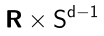 we consider the case of classical CFT in .
In Section Supergravity in AdS space we discuss deformations of and holographic renormalization.
In Section Beta-deformation and its generalizations we study the particular case of beta-deformation Leigh:1995ep.
Finally, in Section Discussion and open questions we discuss some open questions and
potential problems.
we consider the case of classical CFT in .
In Section Supergravity in AdS space we discuss deformations of and holographic renormalization.
In Section Beta-deformation and its generalizations we study the particular case of beta-deformation Leigh:1995ep.
Finally, in Section Discussion and open questions we discuss some open questions and
potential problems.