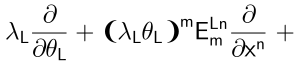
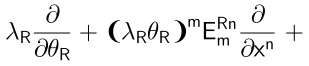
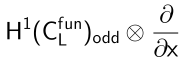
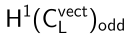
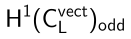
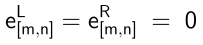
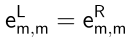
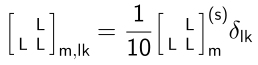
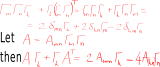
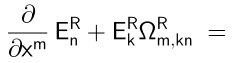
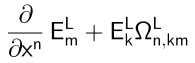
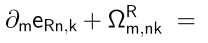
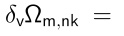
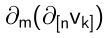
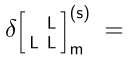
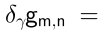
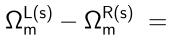
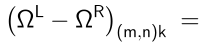
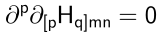
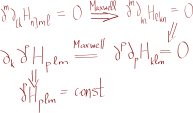
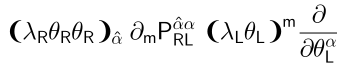
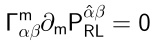
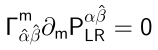
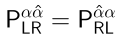
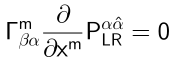
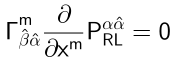
Coefficients of normal form satisfy wave equations
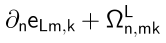
Equations for tetrad and spin connection
Fixing 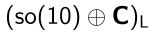 and
and 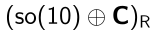
Fixing  and
and 
Einstein equations
Antisymmetric tensor
Equations for bispinors
Equations following from 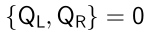
Equations for RR bispinor following from 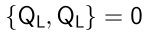
Modulo

we can choose the coordinates so that:
where

are some functions of

.
Indeed, using
〚
First page〛:
Equations for tetrad and spin connection
Fixing and
Let us study the linearized order in deviations from flat space-time. In flat space-time
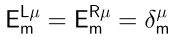
. The deviation from
flatness can be written as:
where

and

are infinitesimal. We assume summation over repeated indices.
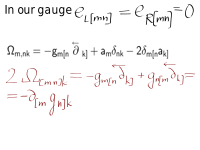
We can choose a freedom of
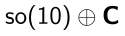
redefinitions
of both

and

to fix:
At this point, the only remaining freedom in redefinition of

and

is overall rescaling of
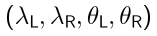
.
We fixed both

down to the diagonal

.
Fixing and
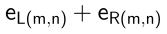
According to 〚
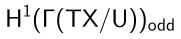 and
and 
〛, we can choose:
From
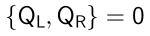
, the coefficient of

, projected to
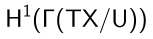
(see Eq. (
33)):
Similarly with

:
Eqs. (
43) and (
44)
and similar equations with
determine
and
in terms of

and

.
Eqs. (
44) and (
45) guarantee the cancellation of the obstacle
in
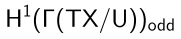
,
i.e. the one containing

.
It remains the coefficient of
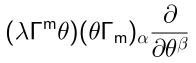
(see Eq. (
25)).
This will cancel by

and

, see 〚
Equations following from 〛.
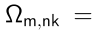
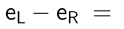
Let us denote:
and similar definition for

in terms of
.
This notation is useful, because for any vector

:
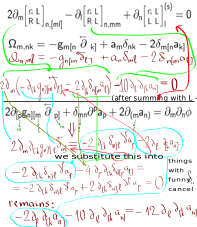
From
, the coefficient of
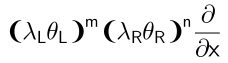
:
Equivalently:
Eq. (
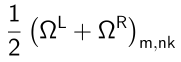
46) is zero torsion of the “average” (
i.e. left plus right)
connection.
Einstein equations
Let us denote:
Then Eq. (
46) implies the existence of

such that:
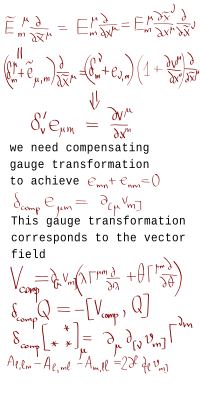
Infinitesimal coordinate redefinition
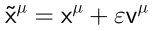
, followed a compensating rotation
of
and
in order to preserve Eq. (
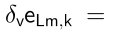
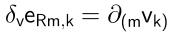
41), corresponds to:
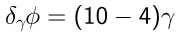
The overall rescaling
corresponds to:
From
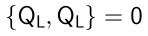
and
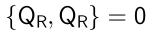
follows that

and

both satisfy
Maxwell equations:
Considering the scalar part, we conclude that
satisfies the Maxwell equations:
and

satisfies:
It follows from the symmetry

that exists

such that

. Therefore:
The rescaling Eqs. (
50), (
51) and (
52) are accompanied by:
With Eq. (
54), the consistency of the sum of Eq. (
44) and Eq. (
45)
requires, modulo zero modes:
and therefore
can be gauged away:
fixing the overall rescaling gauge symmetry of Eq. (
49).
Antisymmetric tensor
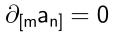
Eq. (
47) implies, after total symmetrization:
Modulo finite dimensional spaces, Eqs. (
56), (
47) and (
42) imply that (
cf Eq. (
64)):
Therefore

is antisymmetric:
The consistency of the difference of Eq. (
44) and Eq. (
45)
implies that

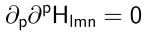
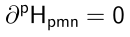
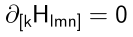
is harmonic:
and, modulo a constant, divergenceless:
Then:
Equations for bispinors
Equations following from
Considering terms proportional to 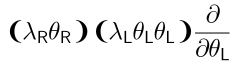 and similar terms with , we need to require that they cancel similar terms in
〚Fixing and 〛.
and similar terms with , we need to require that they cancel similar terms in
〚Fixing and 〛.
This implies that modulo zero modes:
The antisymmetric tensor field
should be identified with the field strength of
the NSNS B-field:

.
Now consider the terms proportional to
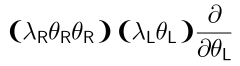
:
It is cancelled by adding:
leading to the extra term:
There is a similar contribution with

. For them to cancel each other, we need:
Equations for RR bispinor following from
To get
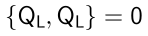
and
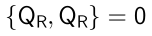
we need: