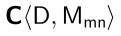
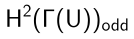
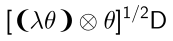
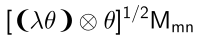
Cohomology of  in the space of vector fields
Notations
Summary of results for 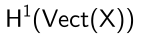
Exact sequences
Computation of 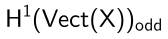
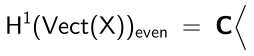
Summary of result
Computation
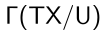

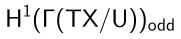 and
and 
Computation of 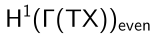
Summary of result
Computation
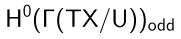
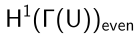
Computation of 
Computation of 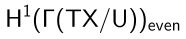 and vanishing of
Notations
Let

denote the singular supermanifold parametrized by bosonic

and fermionic

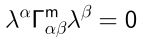
satisfying the pure spinor constraint:
(The space

introduced in
〚
Definition of 〛
is the direct product of two copies of
, and the space parametrized by

.)
Let

denote the algebra of polynomial functions on
, and

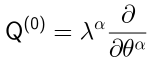
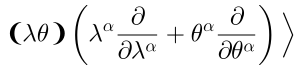
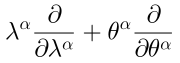
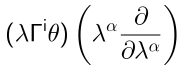
the space of polynomial vector fields. Consider the odd nilpotent vector field
:
The commutation

is a nilpotent operator on

.
We will now compute the cohomology of this operator.
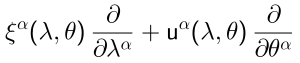
Any vector field
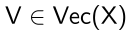
can be written as
The condition
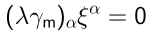
is needed because
is constrained to satisfy Eq. (
18).
Consider the subsheaf

consisting of vectors of the form

(in other words,

). Its space of sections is:
We observe that
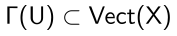
is invariant under the action of

.
Therefore, we can think of both

and
as complexes with the differential
.
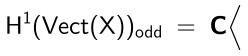
Summary of results for
In the rest of this Section we will explain the computation.
Exact sequences
Consider the short exact sequence of complexes:
The corresponding long exact sequence in cohomology of
is:
Computation of
Summary of result
We use the following segment of the long exact sequence:
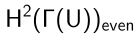
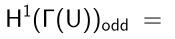
The cohomology groups participating in this segment have the following description:
This implies:
We will now explain the computation.
Computation
The space
is generated as an
-module, by the following vector fields:
However
is
not a free
module, because there is a relation:
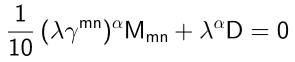
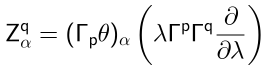
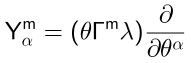
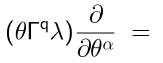
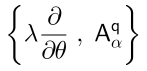
It is zero because both  and
and  can be extended to elements of
  commuting with
:
commuting with
:
and
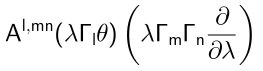
For any tensor

, consider vector fields of the form:
Such vector fields generate
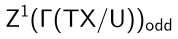
.
But some of them are
-exact:
Therefore the vector fields of the form Eq. (
29) with
of the form:
are zero in
. This implies that
is generated by
the vector fields of the form:
A vector field of Eq. (
29) is zero in cohomology iff:
Vector fields of the form (
32) correspond to:
Notice that the section of
defined by Eq. (
32) can be extended
to a
-closed section of

:
This means that
is zero.
Eq. (
30) has the following refinement:
Computation of
Summary of result
Computation
We use the following segment of the long exact sequence:
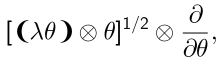
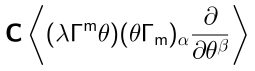
is generated by:
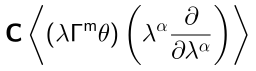
is generated by:
Computation of
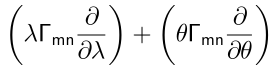
The linear map
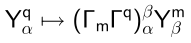
is a bijection. More precisely:
Therefore 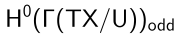 cancels with .
Computation of and vanishing of
The space of cocycles
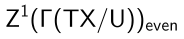
is generated by:
where
and
are from Eq. (
26).
Since both
and
extend to
-closed sections of
by Eqs. (
27)
and (
28), the coboundary operator
is zero.
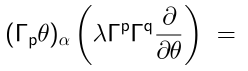
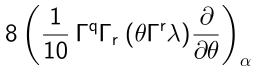
But some cocycles are exact. Indeed, as sections of

: